Bound Water Dynamics and Phase Change Thermal Engineering Lab.

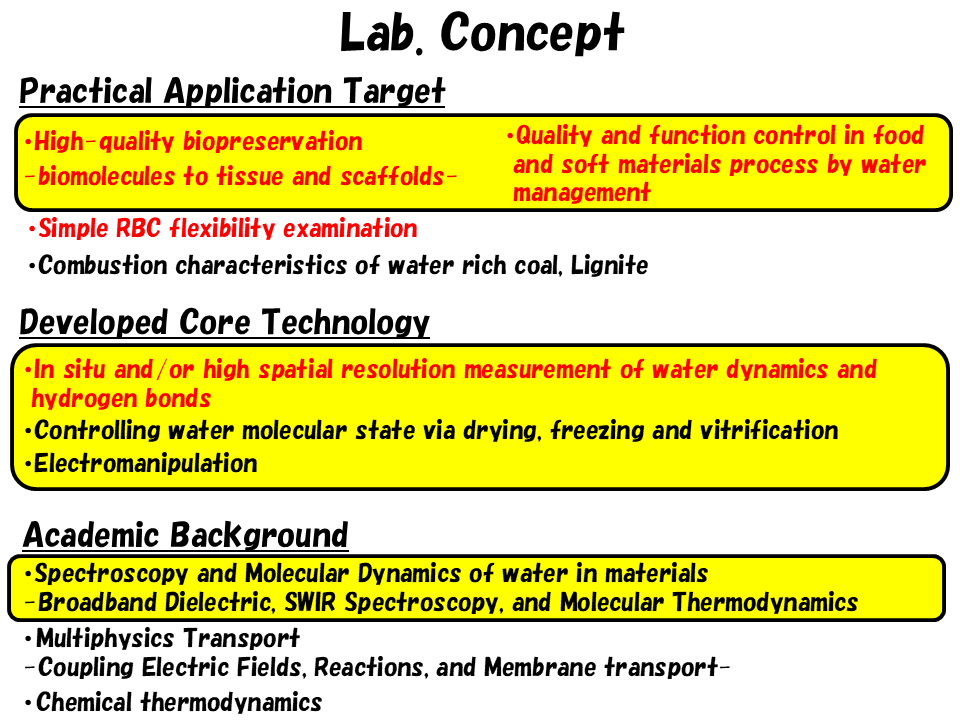
1. How can we Predict, Evaluate, and Control the Degradation of Biological Systems and Materials?
Biological systems—including proteins, cells, and tissues—as well as food products and biodegradable materials, present unique challenges in preservation.
Unlike industrial materials, biological entities undergo rapid degradation because they rely on internal water as a medium for continuous chemical reactions.
To achieve high-quality preservation, it is essential to suppress or halt these reactions. This is typically done by removing the water medium or inhibiting molecular motion through techniques such as freezing or dehydration.
However, these processes can be physically damaging. To prevent the destruction of the biological structure during freezing or drying, we investigate the strategic addition of cryoprotectants and other protective substances.
Our research aims to bridge the gap between molecular behavior and long-term stability to master the control of biological degradation.
2. How Does Bound Water Influence the Fundamental Properties of Materials?
Materials containing moisture, such as biological tissues and food products, are characterized not only by their water content but also by the molecular-level interaction between water and the host material.
This allows us to classify water into two categories: bulk water and bound water.
The physical behavior of these water molecules differs dramatically. While bulk water molecules undergo rotational motion (rotational relaxation) with a period of approximately 8 picoseconds, bound water can see this period extend to few orders longer or more, when vitrified (glass-like).
This state of motion and the binding strength significantly influence the material's overall bulk properties, including transport properties, decomposition rates and mechanical characteristics.
To analyze these phenomena, we utilize advanced spectroscopy techniques:
- Shortwave Infrared Spectroscopy to measure hydrogen binding energy which is translated to the molecular rotational relaxation.
- Dielectric Spectroscopy to determine the molecular rotational relaxation.
Our research leverages these insights to understand and control the fundamental properties of moisture-laden materials and hydrated biomaterials at the molecular scale.