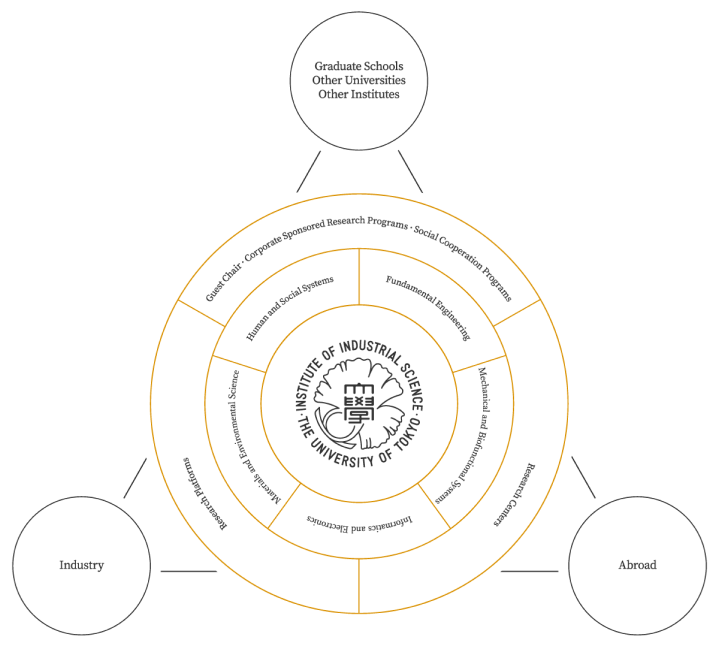
Operational Structure
At the Institute of Industrial Science (IIS), extensive research ranging from basic to applied in a wide variety of engineering fields is conducted across approximately 160 laboratories, which are primarily led by professors, associate professors, and lecturers. Each of the laboratories is affiliated to one of the five departments or eight research centers.
Research activities include both innovative research based on the original ideas of researchers and the dissemination of the obtained results throughout the society.

Five Research Departments and Research Centers
Laboratory System
Research in the IIS is conducted by each laboratory as a basic unit headed by an individual professor, associate professor, or lecturer. These faculty members choose their own research topics and conduct research with their original methods. This laboratory system plays an important role in the promotion and development of creative research. Each of the laboratories is affiliated to one of the five departments or eight research centers.
Click Here
Organization of Research
Group Research, in which multiple laboratories work together voluntarily, is actively organized in the IIS. These studies are conducted on various levels - from Research Unit comprising researchers in similar fields to large-scale projects involving cooperation among researchers from different fields in accordance with pre-determined plans and purposes.
Research centers and collaborative research centers are the major outcomes of the activities of the Research Units. The flexible organization of the research groups facilitates faster and more dynamic expansion and development of research.
Research Funds
Research costs in the IIS are covered by the Operational Expenses Subsidy provided by the Ministry of Education, Culture, Sports, Science and Technology (MEXT), various competition-based subsidies awarded on the basis of applications such as Grants-in-Aid for Scientific Research, collaborative research with private sectors, and endowments from industry. A fixed portion of these funds is kept by the institute and is distributed to early-stage but promising research activities based on internal competition and the discretion of the IIS director general.
Click Here
Cooperation with Graduate Schools and Other Departments and Organizations
The IIS cooperates with the University of Tokyo's Graduate Schools including Engineering, Science, Arts and Science, Frontier Science, Information Science of Technology, Interfaculty Initiative in Information Studies, and related Undergraduate Schools, and has strong link with the Research Center for Advanced Science and Technology located on the same campus. Cooperative activities are conducted in the IIS not just with these schools and institutes, but also with other organizations, both within and outside Japan. For example, the Laboratory for Integrated Micro-Mechatronic Systems (LIMMS) is managed in cooperation with Centre National de la Recherche Scientifique (CNRS), France.
Click Here
Cooperation with Industry
The research of the IIS ranges widely from basic engineering to applied technology; therefore, it is essential to promote research and development in cooperation with industry.
For this purpose, cooperative research with private sector and funded research are conducted, and further contacts and exchanges with researchers in private sectors are promoted. Furthermore, endowments from the private sectors have enabled us to establish and maintain endowed chairs, to which project professors and project associate professors from outside are appointed. Thus, as a university affiliated research institute open to society, IIS makes every effort to promote engineering research and to make use of research results to contribute to society.
Click Here
Research Management Office
The Research Management Office (RMO) was established to promote the planning, coordination, and management of research at IIS. The RMO supports the education and research activities of the faculty, such as planning research strategies, procuring external funds, and promoting government-industry-academia collaboration.
Simultaneously, to improve the management of the institute, the RMO acts as internal liaison and coordinator between faculty and administrators for activity evaluations, education and research publicity, intellectual property strategy, promoting international cooperation, etc.
Technology Licensing Organization (TLO)
The objective of this organization is to transfer new knowledge and skills gained through research to the development of new industrial applications.
A government-recognized technology licensing organization (TLO) is established in the Foundation for the Promotion of Industrial Science and is operated as a platform for making academic research visible.
|
|